OpenClaw 2026.11.4: The Patch That Stops Losing Team Messages
A standing approval setting for delegated changes, policy plugins that inspect images before they reach a model, and fixes for messages lost on reconnects and restarts.
Dzianis Vashchuk
3 min read
OpenClaw 2026.11.4 is a patch release, and I think a patch that stops losing messages matters more for a team than a feature release. The GitHub release counts 220 commits, 125 pull requests, and 90 contributors. The release summary names the harm in plain terms: buffered Signal messages could be skipped after a reconnect, replies could be lost after a settings reload, and memory and configuration recovery copies could be damaged. I read the release notes as a record of work a team can lose on a normal day.
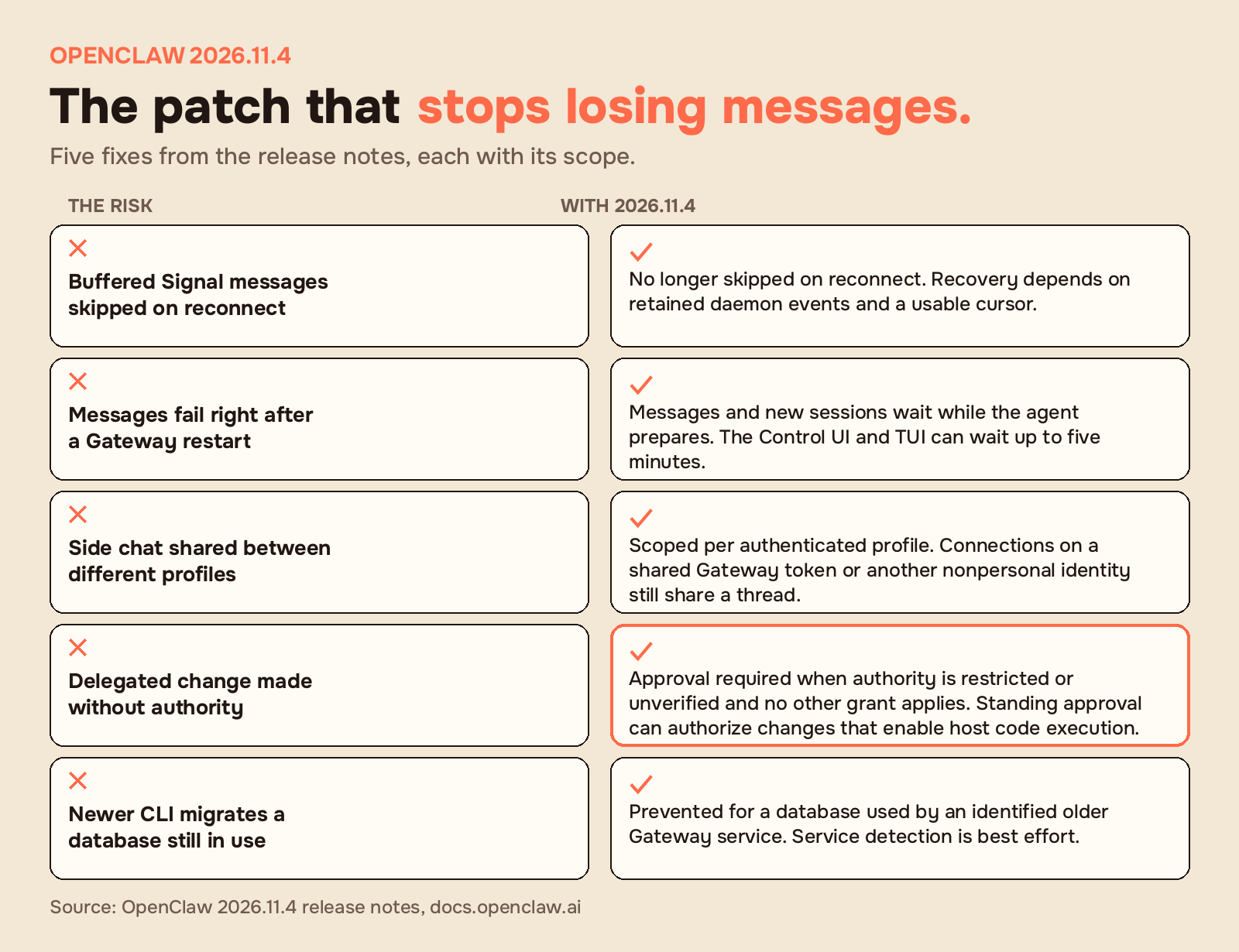 The left card names the risk, and the right card names the fix in 2026.11.4 with its scope from the release notes.
Messages that no longer vanish
The Gateway is the running OpenClaw service named in each of these fixes. Buffered Signal messages are no longer skipped when the native HTTP connection reconnects. Recovery depends on retained daemon events and a usable cursor. WhatsApp final replies no longer disappear when unrelated settings reload during a turn. Messages and new sessions no longer fail immediately after a Gateway restart while their agent is still preparing. The Control UI and TUI can wait up to five minutes for the agent. The release also reduces the amount of retained conversation data loaded when checking for interrupted sessions after a Gateway restart.
Private material stays in its place
Side chat questions and answers are no longer shared between different authenticated profiles viewing the same session. An authenticated profile is the signed-in identity a person uses to view the session. Connections using a shared Gateway token or another nonpersonal identity still share a thread. Paired-node screenshots and photos used for inspection are no longer attached to outgoing messages automatically. Their saved paths can still be shared explicitly. Captured model-only prompt guidance no longer appears in chat history or live message display metadata, and it is preserved for replay. Policy plugins can inspect images and block a run before those images reach a model.
Delegated changes need approval first
A delegated persistent change is a lasting change made through OpenClaw on someone else's authority. OpenClaw now requires approval for delegated persistent changes when authority is restricted or unverified and no other grant applies. The release adds a standing approval setting for permitted delegated changes. Read the warning before using that setting. Full Access or standing approval can authorize changes that enable host code execution even when direct execution or editing tools are denied. A separate fix covers a grant withdrawn mid-work. A revoked autoApproveChanges grant is rechecked when settings change during a run, even when the run keeps earlier model settings.
An early update leaves a database in use alone
The CLI is the OpenClaw tool a person runs by typing commands in a terminal. A newer CLI is prevented from migrating a database still used by an identified older Gateway service. Service detection is best effort. When migration is refused, the notes direct the reader to run openclaw update or use the service installation's CLI. Manual trimming of large session transcripts no longer exhausts memory when only a small recent tail is kept. Doctor uses less memory when repairing large SQLite transcript histories, and interrupted repairs can resume. An old Control UI Files draft cannot overwrite a replacement managed workspace, and the unsaved draft is kept when the workspace source changes.
Records keep secrets out of shared copies
Recognized multiline secret assignments no longer appear in exported OpenTelemetry attributes when model and tool content capture is enabled. OpenTelemetry attributes are the labels and values attached to exported records from a run. Recognized credentials no longer appear in quoted compaction context saved and replayed in summaries. The original transcript remains unchanged.
You can deploy OpenClaw in one click for your team at agentpod.agentlabs.cc.